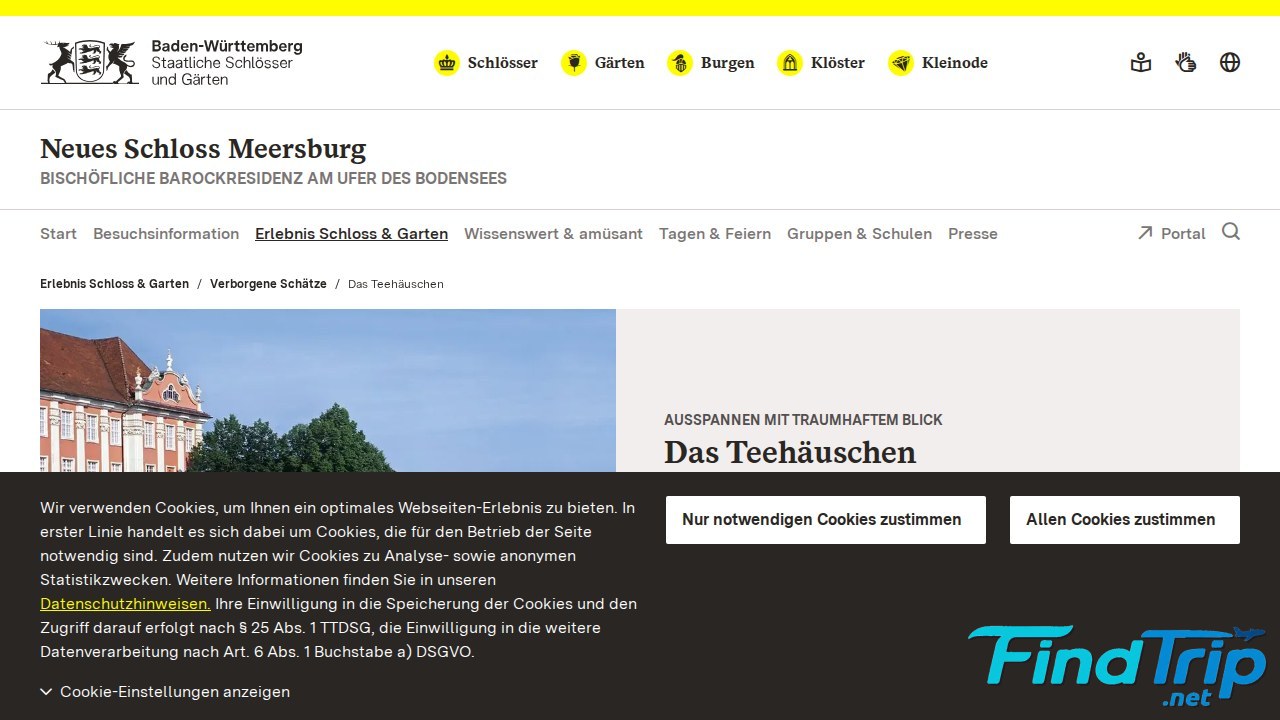
Teehäuschen at Neues Schloss Meersburg
Fact sheet and site guide for the Teehäuschen garden pavilion at Neues Schloss Meersburg in Bodenseekreis, featuring historic facts and site details.
Nestled along the scenic lower terraces of the palace gardens at Neues Schloss Meersburg in the Bodenseekreis district of Baden-Württemberg, the Teehäuschen stands as an exquisitely preserved architectural monument from the era of prince-bishop rule. Following comprehensive conservation and restoration efforts, this historic garden pavilion provides modern visitors with an intimate look into the courtly entertainment traditions and aristocratic retreat spaces of 18th-century Southwestern Germany.
Available Place Information
The following structured fact sheet compiles the available logistical, administrative, and spatial details regarding the Teehäuschen based strictly on public heritage documentation and official site listings.
- Official Name: Teehäuschen (frequently referred to as Das Teehäuschen or the Palace Garden Pavilion of the New Palace Meersburg).
- Geographic Address: Bodenseekreis, Baden-Württemberg, Germany (DE). Located on the terraced grounds directly below the main garden of Neues Schloss Meersburg overlooking Lake Constance.
- Official Website: [Neues Schloss Meersburg - Das Teehäuschen](https://www.neues-schloss-meersburg.de/erlebnis-schloss-garten/verborgene-schaetze/das-teehaeuschen/)
- Property Type: Historic Garden Pavilion / Cultural Heritage Monument / Architectural Landmark.
- Direct Telephone Contact: Not specified on the individual pavilion document. General inquiries regarding access, group tours, and special events must be routed through the central administrative office of Neues Schloss Meersburg or the managing state entity (Staatliche Schlösser und Gärten Baden-Württemberg).
- Operating Hours: Not listed independently for the pavilion structure. Visitors should note that access to garden structures is generally tied to the seasonal opening schedule of the main Neues Schloss Meersburg complex and its associated park grounds. It is advised to consult the primary site portal prior to planning a visit.
- Admission Pricing: Individual ticket rates specifically dedicated to the interior of the Teehäuschen are not separately published on the source page. Entry protocols are typically integrated into general palace admission, garden access passes, or guided specialized tours.
- Geographic Coordinates & Transport Links: Precise GPS coordinates and local public transport lines (such as specific regional bus stops or Lake Constance ferry docks) are omitted from the single-entry source document. Visitors traveling to the site navigate via standard routes to Meersburg's historical upper town (Oberstadt) and descend through the marked garden paths.
Key Insights from Official Sources
Documentation provided by the state heritage portal highlights several key historical, architectural, and operational facts regarding the Teehäuschen:
- Historical Role as an Aristocratic Retreat: Positioned strategic steps below the formal palace gardens, the pavilion originally served the ruling prince-bishops (Fürsten) as a private sanctuary. It provided a quiet space away from the strict ceremonial protocols and public duties associated with the main residence, allowing the ruling elite to relax in a secluded natural setting.
- Venue for Intimate Social Gatherings: Beyond individual contemplation, the structure was purposefully designed to host small, exclusive gatherings (kleine Gesellschaften). These private functions allowed the prince-bishops to entertain high-ranking guests, select courtiers, and visiting dignitaries in an informal atmosphere characterized by conversation, music, and light refreshments such as tea or coffee.
- Comprehensive Conservation and Restoration: The pavilion has recently undergone extensive conservation and structural restoration work aimed at preserving its delicate historic fabric. These meticulous works addressed long-term weathering issues, restored interior decorative details, and secured the stability of the exterior, ensuring the structure remains a lasting cultural landmark.
- Representation of Courtly Culture: Thanks to its successful restoration, the garden pavilion serves as a vibrant, tangible witness to the courtly life and architectural ambitions of the prince-bishopric. The interior aesthetic and exterior proportions reflect the refined taste, artistic patronage, and social customs prevalent in Southwestern German noble courts during the late Baroque and Rococo eras.
- Classification as a "Hidden Treasure" (Verborgene Schätze): Within the official visitor interpretation framework (Erlebnis Schloss & Garten), the Teehäuschen is categorized under the dedicated section for hidden treasures. This designation draws visitor attention to specialized, smaller-scale architectural gems located across the estate grounds that lie beyond the standard palace museum route.
- Integration with Regional Heritage Management: The monument operates under the umbrella of Staatliche Schlösser und Gärten Baden-Württemberg, the official state agency responsible for preserving historic castles, gardens, and monasteries across the state. This connection ensures high standards of ongoing historic conservation and professional educational interpretation.
Editorial Commentary
From a cultural management and architectural history perspective, small pleasure pavilions like the Teehäuschen represent an essential yet often overlooked element of European garden design. While grand royal residences such as Neues Schloss Meersburg were engineered to project sovereign authority, political influence, and monumental prestige, smaller auxiliary structures were specifically built to humanize the landscape and accommodate private domestic life. The decision by Staatliche Schlösser und Gärten Baden-Württemberg to highlight the Teehäuschen within their "Hidden Treasures" initiative demonstrates a commendable commitment to holistic heritage conservation, ensuring that secondary court structures receive equal scholarly and restorative care. For travelers exploring the Bodensee region, visiting this pavilion provides crucial spatial context, illustrating how 18th-century landscape architects seamlessly integrated structured garden terraces, scenic lake vistas, and intimate architectural retreats to create a cohesive environment dedicated to leisure, reflection, and high status.
Official Links and FindTrip Integration
To verify current opening schedules, special tour availability, and general palace grounds access, travelers are encouraged to review official primary sources directly:
- Official Web Page: [Neues Schloss Meersburg - Das Teehäuschen](https://www.neues-schloss-meersburg.de/erlebnis-schloss-garten/verborgene-schaetze/das-teehaeuschen/)
For seamless travel planning, itinerary management, and local mapping when visiting Baden-Württemberg, open this location directly on FindTrip using the official tracking reference: `DE1788818898915`.
Summary Conclusion
As a meticulously restored masterpiece of 18th-century garden architecture, the Teehäuschen offers an enriching historical detour for anyone exploring the picturesque grounds of Neues Schloss Meersburg above Lake Constance.